Glowforge Spark vs Snapmaker Ray 20W
| Laser | ||
| Type | Diode Laser | Diode Laser |
| Longueur d'onde | 455 nm | 455 nm |
| Puissance optique | 6 W | 20 W |
| Performance | ||
| Zone de travail | 203 × 305 mm | 400 × 600 mm |
| Vitesse max | 8,000 mm/min | 30,000 mm/min |
| Mise au point | Mise au point auto | Manuelle |
| Fonctionnalités | ||
| Enceinte | Oui | Non |
| Assistance air | Non | Oui |
| Compatible rotatif | Non | Oui |
| WiFi | Oui | Oui |
| Caméra | Oui | Non |
| Physique | ||
| Prix approx. | $899 | $1,299 |
| Année de sortie | 2024 | 2023 |
| Poids | 4.9 kg | 14.6 kg |
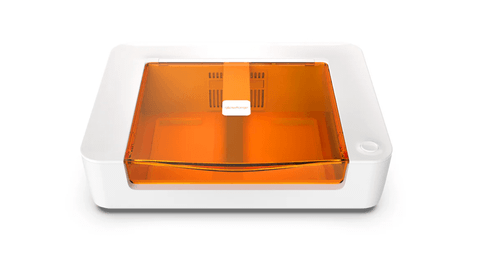

Glowforge Spark
Ce qu'on aime
- Easiest laser to get started with — ~30-minute setup
- Free Glowforge Print software works on any device (Mac, PC, tablet, phone)
- Built-in camera with live preview for material placement
- Class 1 enclosed — safe for home and classroom use
- Wide material library with auto-detected settings
Points d'attention
- Cloud-dependent — requires internet for every job
- Small 203×305mm cutting area for the price
- Only 6W — limited cut depth and no thick stock
- Subscription costs for premium design catalogue
- Not compatible with LightBurn
Snapmaker Ray 20W
Ce qu'on aime
- Smart Air Assist pump included in box
- Large 400×600mm work area
- Wi-Fi + USB connectivity
- LightBurn compatible out of the box
- Strong Snapmaker community and ecosystem
Points d'attention
- No autofocus (manual focus lever)
- No built-in enclosure (sold separately)
- No camera for material detection
- Lower power than 40W model
Glowforge Spark
Snapmaker Ray 20W
Le Glowforge Spark coûte 899 $ (31 % de moins) que le Snapmaker Ray 20W, proposé à 1,299 $.
Le Snapmaker Ray 20W offre 70 % de puissance optique en plus (20W contre 6W).
Le Snapmaker Ray 20W propose une zone de travail 74 % plus grande (400 × 600 mm contre 203 × 305 mm).
Le Snapmaker Ray 20W atteint une vitesse maximale 73 % supérieure (30,000 mm/min contre 8,000 mm/min).
Côté fonctionnalités, le Glowforge Spark dispose de un capot fermé, contrairement au Snapmaker Ray 20W; le Snapmaker Ray 20W dispose de l'assistance air, contrairement au Glowforge Spark; le Glowforge Spark dispose de une caméra, contrairement au Snapmaker Ray 20W; le Snapmaker Ray 20W dispose de la compatibilité avec un accessoire rotatif, contrairement au Glowforge Spark.